


Welcome to Tsera
.png)
In Tsera, we invite you to join us on a journey towards a life that cherishes simplicity and fosters deep connections. Here, we create a world where each day is imbued with meaning and tranquility. Welcome to our community.
Vision
We aspire to a society where simplicity and holistic well-being shape daily life in Tsera. We envision a future in which true connections with each other and with nature are deepened through meaningful relationships and sustainable practices. Our community is rooted in minimalism and cultural wisdom, in harmonious synchrony with the earth.
Mission
Tsera is committed to building a community grounded in simplicity, health, and environmental care. Our mission is to empower our citizens with the resources for holistic well-being and to strengthen family and community bonds while promoting sustainable living. For newcomers and visitors, Tsera offers a rich tapestry of experiences, interwoven with nature, culture, and authentic human connection, encouraging shared growth and meaningful contributions.


Embrace the Essence of Tsera
In the heart of a world that often rushes past its own beauty, Tsera stands for a life reconnected with simplicity, harmony, and purpose. Here is a glimpse into what defines us—our DNA, that guides our path.


Infographic
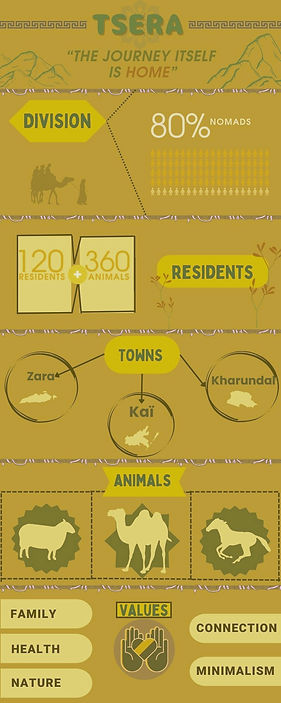

The Historical Background of Tsera
"The journey itself is home"
In the heart of a vast, dry desert where shimmering oases appear like illusions and endless plains stretch as far as the eye can see, lies the beautiful land of Tsera. Tsera is a place deeply connected to its ancient past, where the lives of its people move to the natural rhythm of the land, guiding them from one grazing area to another. About 120 strong and tenacious nomads call this rugged yet captivating land home. They share their lives with a caravan of 360 trusted animals. Through strong family bonds and a determined spirit, the people of Tsera live in harmony with nature, creating a rich culture centered around their nomadic lifestyle and self-sufficiency.
A Land Rich in History
Although Tsera has a small population, its cultural history is rich and vast. The story of Tsera begins with its three important cities, each named after key figures whose stories are woven into the nation's history. The capital, Kaï, is named after a warrior hero, celebrating the spirit of bravery. Yet, Tsera's past also has a shadow. Kaï's brother, Kharundal, is remembered in the name of a cold, northern city. Legends speak of Kharundal's jealousy, leading him to commit a terrible act by killing Kaï over the love of a woman named Zara.
Zara is also the name of a coastal city, where 20% of Tsera's people live, surrounded by stories of lost love and despair. After Kaï's death, Zara's heartbreak ended her own life. She was laid to rest beside Kaï, symbolizing their eternal bond. Full of regret, Kharundal fled to the cold north, where he lived out his days in sorrow.
Every year, the people of Tsera remember this touching history with a memorial journey. Nomads from all over the land come together, traveling with their loyal camels from Kaï to Tsera, in a traditional pilgrimage to honor their past heroes.
Orphans of the Desert
Today, Tsera stands as a symbol of community and peace, welcoming orphans in search of belonging and comfort. These individuals find a place in Tsera's lively nomadic traditions. The original settlers, who were also nomads, see this land as sacred. Experts in cattle herding, they move continuously, taking their lives and animals with them.
The first settlers in Tsera saw potential in the challenging landscape, building a lively trade system by exchanging livestock with eager merchants. This spirit of innovation is rooted in their oldest stories, tales of the two brothers passed down over generations, keeping important lessons and values alive. Around campfires, stories of survival and bravery remind the people of Tsera of their steadfast values: family, nature, and connection.
In the Spirit of Tsera
In Tsera, truly, the journey is home. It is a place where history, legend, and the spirit of nomadic life come together, forming a land as enduring as the desert winds and as vibrant as the caravans that cross its ancient paths. Here, hand in hand with the land and its tales, the people of Tsera continue to live out their ancestors' legacy, ensuring that each step on their journey becomes a lasting part of their cherished home.
Share

The Ancient Origins of
the New Nomads
Nomadism might seem like a modern lifestyle trend, but it's actually an ancient concept deeply interwoven with human history. Recently more people are revisiting this age-old way of living by embracing digital nomadism. This form of nomadism allows people to use technology to work remotely from anywhere in the world. As Felix Marquardt wisely notes, the desire to embark on a journey or migrate is a fundamental human instinct that goes back centuries.
For most of human history, living as a nomad was the norm. Before agriculture emerged around 12,000 years ago, humans organized themselves in small, mobile groups, constantly on the move in search of food and better living conditions. Agriculture marked the beginning of more settled lifestyles. Yet, not all groups settled down, the Scythians and Mongols, for instance, developed highly dynamic nomadic societies.
Today, nomadism has been romanticized through literature and culture, with iconic figures like Kerouac's Beatniks and Thoreau's transcendentalists celebrating independence, adventure, and nature. In the digital era, the idea of being a nomad has become associated with freedom, minimal living, and personal growth.

Social media has played a significant role in amplifying the appeal of the nomadic lifestyle, presenting it as an inspiring way of life. Hashtags like #vanlife illustrates this ideal, attracting millions to the virtual experience of life on the move. However, while the lifestyle appears glamorous online, it often disguises the challenges in real life. True nomadism isn't just about traveling, it's about embracing the unknown and building bridges across different cultures and communities.

Chloé Zhao's "Nomadland" stands out as a definitive film of the year, portraying a woman's journey across the US in her van after losing everything. The movie's exploration of nomadism as a way to reconnect with nature and find life's meaning. It was a major success during awards season.In essence, the renewed interest in nomadism today is like a modern search for freedom and meaning. A nomadic mindset encourages us to venture beyond the ordinary and reconnect with the world in a time of rapid change.
In essence, the renewed interest in nomadism today is like a modern search for freedom and meaning. A nomadic mindset encourages us to venture beyond the ordinary and reconnect with the world in a time of rapid change.

The Benefits of Reconnecting with Nature
Historically, humans have always felt a strong connection to nature. In some cultures, this connection is a fundamental practice for healing and personal growth. Our preference for natural environments may stem from evolutionary factors, as these settings provided essential resources for survival.
A significant body of research indicates that proximity to nature enhances social, psychological, and emotional well-being. Studies show that viewing nature, even in the form of images or videos, can trigger positive emotions such as admiration, gratitude, and calmness. These responses can lead to better mental health and improved social interactions. Moreover, natural environments can foster social cohesion, trust, and selflessness. Research indicates that individuals living near green spaces tend to exhibit less violence and have a stronger sense of community connectedness. Brief exposure to nature has also been shown to diminish self-importance and increase empathy and generosity toward others.

Additionally, there is compelling evidence that exposure to nature contributes to stress reduction and better physical health outcomes. People residing near green areas experience lower stress levels and associated health benefits, such as reduced cortisol levels. Nature experiences can even aid recovery from illness; studies have shown that patients who had views of nature after cardiovascular surgery recovered more quickly.
However, modern lifestyles often lead to decreased outdoor engagement, contributing to increased stress levels and feelings of being overwhelmed. The term "nature deficit disorder" describes the disconnection individuals feel from the natural world, highlighting the need to seek a deeper connection with the environment around them.


The Tale of the Vegetarian Zombie
Once upon a time in Tsera, a land rich in history, there lived a man a hundred years ago who made many poor choices. He drank heavily and smoked over ten cigarettes a day. He isolated himself and took everything nature provided for granted. Even though he had a family, he prioritized his own desires over their needs, wasting money on himself instead of caring for them.
His hardworking wife managed three different jobs to support their children and keep the home running. Sadly, her heavy efforts took a toll on her health, leaving her unable to work. As her husband spent their money and refused to help her, she became ill and couldn’t get the medical treatment she needed. Tragically, she passed away, leaving their children without parents.
After her death, the man remarried but chose to abandon his children to lead a carefree life. Ever since his wife died, he was haunted by the same dreams that he couldn’t fully remember. Night after night, he woke up in a panic, drenched in sweat and filled with dread.
In his dreams, he heard someone calling his name from the shadows of a forest. Whenever he tried to find the source of the voice, it would disappear, leaving him confused. The next day, after indulging in cigarettes and alcohol, he fainted. He became very sick. The doctors couldn’t explain what diseases he had. In a matter of time, he became thin and aged rapidly.
Wanting to save himself, he decided to change his habits. He quit smoking and drinking and even became a vegetarian. But no matter how hard he tried, his illness didn’t go away. His new wife and children became frightened by his disturbing appearance and left him.
As he continued to waste away, the townspeople began to call him the "Vegetarian Zombie," a man who was so thin that he desperately needed protein but refused to eat meat. One night, while dreaming, he heard children crying in the forest, a sound that pulled at his heart.
When he approached the children, he asked, "Which one of you called my name?" They began to argue, which frustrated him. "It doesn’t matter who you are! How do you know my name, and why did you call me?"
One child stepped forward and said, "I need help. I live in the forest, and if you don’t help me, I will freeze to death." Another child added, "No! I need help too. I’m so hungry that I eat leaves from the trees!" The man felt hopeless and replied, "How can I possibly help? I have my own problems!"
Then one child asked a difficult question: "Which of us would you save first?" After thinking for a moment, he said, "Of course, I would save the one who is dying!" And just like that, the children disappeared.
Suddenly, he saw a vision of his own children from his first marriage. They had been left to take care of themselves after their mother’s death. One child was freezing in the cold, while the other was so hungry that he was eating leaves from the trees. Overwhelmed with grief and regret, the man cried, realizing, "If only I had known... I would have saved both of you!"
At that moment, he understood the curse he had brought upon himself by mistreating his family. The voices he had heard were those of his abandoned children, calling for their father. With this realization, he remembered the scale of justice, which loomed over him, demanding accountability for his neglect and mistakes.
He learned that being ungrateful and ignoring what nature had given him—family, health, and harmony with the environment—had led him down a path of destruction and sorrow.
Eventually, he recognized that he could not escape the consequences of his actions. Just as his wife and children had suffered, he too faced the harsh realities of life.
The moral of the story is a powerful reminder of the importance of caring for what truly matters: the well-being of our loved ones, our health, and our connection to nature.
In Tsera, the tale of the Vegetarian Zombie is passed down through generations, teaching the values of family, responsibility, and the balance needed to live in harmony with nature.


About Tsera - Your Guide to Adventure


Unveil the Mysteries
Welcome to Tsera, a land where minimalism, nature, community, family, and health converge to create a unique experience. Our website is your gateway to discovering the essence of our nomadic country, from market locations to expert desert guides. Immerse yourself in a journey that intertwines nature, culture, and genuine human connections, fostering shared growth and meaningful contributions.


The Noma-Noma Energy Drink: Energize with the Essence of Nomads
Experience the Essence of Tradition with the Nomadic Energy Drink
Delve into the heart of ancient practices with our Nomadic Energy Drink, a carefully crafted blend that brings the simplicity and vitality of a nomadic lifestyle straight to your home. Inspired by the nutrition and availability of natural resources in traditional nomadic societies, this drink is designed to provide a wholesome energy boost in a natural way.
Why Choose the Nomadic Energy Drink?
Harnessing the power of nature, this drink combines the richness of sheep's milk, the natural sweetness of honey and dried fruits, with a hint of ginger and a touch of salt. It's not just a drink; it's an experience of cultural heritage that supports your active, adventurous lifestyle.
Benefits
Natural Energy Boost
-
Natural Sugars: Dried dates or figs offer a quick, natural energy boost with their high sugar and fiber content, making them essential for physical activities like long treks.
-
Honey: This natural sweetener provides not only delightful taste but also instant energy and antioxidants to combat fatigue.
Nutritional Richness
-
Goat Milk: Packed with proteins, fats, and essential amino acids, goat milk aids in muscle building and recovery, crucial for maintaining physical strength.
-
Ginger: Known for its health benefits, ginger aids digestion and has anti-inflammatory properties, contributing to overall well-being.
Hydration and Electrolyte Balance
-
Salt: A pinch of salt replenishes lost electrolytes after exertion, vital in hot or demanding environments.
-
Water: Essential for hydration, water is a refreshing source post-activities like herding livestock or setting up tents.
Accessibility and Stock Management
Easily available and portable, ingredients like goat milk, honey, and dried fruits accommodate a nomadic lifestyle focusing on portability and shelf life.
Adaptation to Environmental Conditions
This beverage can be enjoyed cold or at room temperature, making it versatile for various climates and situations.
Cultural and Traditional Significance
Ingredients like goat milk and honey hold cultural and historical significance within nomadic societies, enriching the communal and social experience of beverage consumption.


Marketing Mix:
Noma-Noma Energy Drink
What is Noma-Noma Energy Drink?
Noma-Noma is a natural energy drink traditionally used by nomads in Tsera to boost energy and stay hydrated.
Product:
-
Nutritious and Natural: Comprising natural ingredients like dried dates or figs, sheep milk, honey, ginger, salt, and water, the drink hydrates the body. It offers a healthy energy boost without the artificial additives commonly found in other energy drinks.
-
Cultural Authenticity: Inspired by the traditional lifestyle of nomadic communities, this drink boasts a unique authenticity. Ingredients such as sheep milk and honey connect consumers with age-old traditions and cultures.
-
Flexible Usage: Can be enjoyed both cold and at room temperature, making it ideal for traveling.
-
Accessible Ingredients: Easily accessible and portable, ingredients like goat milk, honey, and dried fruits cater to a nomadic lifestyle emphasizing portability and shelf life.
-
Eco-friendly and Recyclable: Utilizes recyclable materials because nomads do not only care about their own human nature, but also about the planet, including nature and animals.
Price:
-
Premium Pricing: Given its unique ingredients and cultural story, the drink can be positioned as a premium product. It appeals particularly to health-conscious and environmentally aware consumers willing to pay extra for quality and authenticity. Priced at 3 euros for 25 centiliters, it targets individuals focused on a healthy lifestyle, dispelling the notion that healthy drinks are dull or unappealing.
-
Bundling Options: Future offerings could include discounts on bundle purchases to encourage regular consumption once we have established a base of loyal customers.
Place:
-
Online Sales: Available through a dedicated website and popular e-commerce platforms like Amazon, providing convenient access for consumers.
-
Website Sales: Initially, our products will be sold through our website to build a loyal customer base with minimal risk compared to physical retail.
-
Physical Store Sales: In the future, we aim to expand to physical stores such as health food shops, gyms, and locations where consumers seek healthy foods or beverages.
Promotion:
-
Social Media Campaigns: Utilize platforms like Instagram and Facebook to share stories and visuals highlighting the culture and benefits of the drink. The focus is on introducing our homeland Tsera, generating interest in the country, and thereby attracting interest in related products and services.
-
Free Samples: Organize tasting events to provide consumers with the chance to experience the drink’s unique flavors and benefits firsthand, demonstrating that healthy drinks can also be delicious.
-
Website: Employ SEO strategies in our blog posts to rank high on Google searches. We aim to make our website professional and aesthetically pleasing to attract and retain customers.

Customer Journey:
How to Attract Residents From Pontaris?

